




1. Impurity Profile
Do you know how the possible impurities in drug substance triamcinolone acetonide manufactured by Tianjin Pacific Chemical & Pharmaceutical Co., Ltd were identified and characterised? In the following, we are going to explain this question.
Impurity identification started from the route, not the chromatogram. Each step was examined for its reagents, intermediates, likely by-products and possible degradation paths, and the resulting list was checked against structural alert libraries and against the impurity panels in the USP and BP monographs. Every compound this route could plausibly generate was then either isolated and characterised against a pharmacopoeial reference standard, or identified by spiking and co-elution as the corresponding peak. What survived purification went into the specification as a specified impurity. What was removed upstream stayed out - but only after the purge had been demonstrated with actual batch data. The point of drawing the line there is practical: a process impurity is controlled by reaction parameters and purification, while a degradation product is controlled by packaging and storage, and confusing the two puts the control in the wrong place.
Analysis of Triamcinolone Acetonide API Impurity Profile
| Impurity Name |
|
|
Control strategy | ||
| EP Impurity B |  |
Process Impurity | Controlled in the specification as individual impurity≤0.3% | ||
| EP Impurity C | 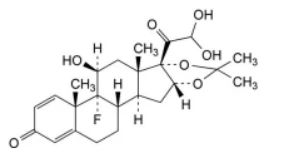 |
Process Impurity | Controlled in the specification as individual impurity≤0.3% | ||
| Triamcinolone acetonide acetate |  |
Process Impurity(intermediate) | Controlled in the specification as individual impurity≤0.3% | ||
| Acetonide Hydrolysate |  |
Process Impurity | Controlled in the specification as individual impurity≤0.3% |
The 0.3% limit is deliberate rather than default. The ICH Q3A qualification threshold at this dose level is 0.15%, so a 0.3% limit obliges the applicant to qualify each specified impurity, through toxicology or through its presence in the batches used in safety studies. One limit for all these impurities keeps the method to a single decision point.
The acetate is the only one whose origin is fully known, because it is a Process Impurity on the route rather than a stray by-product. Its limit therefore does double duty, as an impurity control and as an indirect check that the deprotection step went to completion. A batch at 0.29% acetate is compliant on paper but tells the process chemist something that EP Impurity B at the same level would not.
2. Inorganic Impurities
Based on the synthesis process of Triamcinolone Acetonide API, reagents such as potassium permanganate, sodium sulfite, perchloric acid, hydrofluoric acid, potassium hydroxide, and ammonia water are utilized. All inorganic salts can be removed by water washing. Inorganic impurities in the purified triamcinolone acetonide intermediate are controlled via the Residue on Ignition test, with a control limit of 0.2%.
Residual Solvents
Based on the synthetic routes of the starting material and the drug substance, the residual solvents introduced during the manufacturing process of this product were studied. The organic solvents used are summarized as follows:
| Solvent Name | Class | Used steps | Control strategy | Limit |
| Chloroform | 2 | Step 4, Step 5, Step 6, Step 7 | Included in the final substance specification. | 0.006% |
| Methanol | 2 | Step 4, Step 5, Step 6, Step 7 | Included in the final substance specification. | 0.3% |
| Acetic acid | 3 | Step 2, Step 6 | In the study on loss on drying of the purified triamcinolone acetonide intermediate, the results of multiple batches were all less than 0.2%, indicating that the manufacturing process can effectively remove acetic acid; therefore, this item is not included in the final substance specification. | / |
| Ethanol | 3 | Step 8 | Introduced during the final purification step and included in the final substance specification. | 0.5% |
| Acetone | 3 | Step 1, Step 2 | Included in the final substance specification. | 0.5% |
| Formic acid | 3 | Step 1 | In the study on loss on drying of the purified triamcinolone acetonide intermediate, the results of multiple batches were all less than 0.2%, indicating that the manufacturing process can effectively remove formic acid; therefore, this item is not included in the final substance specification. | / |
| DMF | 2 | Step 3 | In the study on residual solvents in the Triamcinolone Acetonide Acetate intermediate, the results of multiple batches were all less than 10% of the limit (0.088%); therefore, this item is not included in the final substance specification. | / |
| Ethyl acetate | 3 | Step 4, Step 5 | In the study on residual solvents in the Triamcinolone Acetonide Acetate intermediate, the results of multiple batches were all less than 10% of the limit (0.5%); therefore, this item is not included in the final substance specification. | / |
In the above eight solvents, four solvents are in the specification well four are out. The four solvents that stay are the ones a reviewer expects: two solvents in class 2 with tight limits are used across four consecutive steps, in which no later step is guaranteed to clear them up, and two solvents in class 3 are at the final purification and at the opening steps.
The four solvents are not in the specification, which is argued but not assumed. Acetic and formic acid are volatile and they are picked up by loss on drying, which runs under 0.2% across multiple batches against a 0.5% class 3 limit. DMF and ethyl acetate were measured at the acetate intermediate process and the results show that they are in below 10% of their limits, a full order of magnitude of headroom. Both arguments assume that it is a stable process. If the route is changed, the four exclusions have to be re-established.


